Choosing a Portable Car Lift: What to Know About Lift Height, Bay Space, and Clearance
Understanding the Dimensions That Matter Most
When you start looking at equipment for raising vehicles in a home garage or small shop, the numbers on the spec sheet can be confusing. Lifting height, bay space, and ceiling clearance are three measurements that determine whether a lift will actually work in your space. Getting them right means the difference between a smooth installation and a lift that simply doesn't fit.
Lift Height: How High Does the Platform Go?
Lift height is the maximum vertical distance the platform can travel from its lowest position to its highest. For a portable car lift, this measurement is usually somewhere between 48 and 72 inches. That range covers most passenger vehicles and light trucks, giving you enough room to work underneath while seated on a creeper or standing slightly bent.
But the number on the spec sheet isn't the whole story. The actual working height you get depends on the thickness of the lift's platform and any adapters you use. If the platform itself is four inches thick, then a rated lift height of 60 inches gives you only 56 inches of clear space beneath the vehicle's chassis. That matters when you are trying to slide an engine jack or a transmission stand underneath.
Also consider the vehicle's own ground clearance. A low-slung sports car may need less lift height to get comfortable access, while a lifted pickup might require the full range. Always compare the lift height to the vehicle's wheelbase and the type of work you plan to do. Routine oil changes need less height than transmission removal.
Bay Space: Fitting the Lift Into Your Garage
Bay space refers to the floor area the lift occupies when it is in use. Portable car lifts come in different footprints, from narrow models that fit into a single-car bay to wider versions that handle larger vehicles. The critical dimensions are width and depth, but runway length also matters.
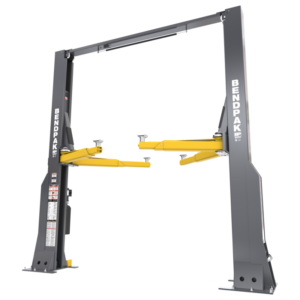
Runway length is the total distance from the front of one ramp to the back of the other. For a four-post lift, that is roughly the distance between the front and rear posts. For a two-post or scissor-style lift, it is the length of the platform itself. If the runway is too short, the vehicle's tires may overhang the platform at one end, which can shift weight distribution and make the lift feel unstable.
Before buying, measure the floor space in your bay, including clearance around the lift for walking, rolling tool carts, and opening car doors. A lift that fits in the bay but leaves no room to move around it is frustrating to use. Also check the concrete thickness under the bay. Most portable lifts do not require bolting to the floor, but the concrete must be thick enough to support the combined weight of the lift and the vehicle without cracking. A typical minimum is four inches of reinforced concrete, though heavier lifts may need more.
Ceiling Clearance: The Overhead Dimension
Ceiling clearance is the vertical distance from the floor to the lowest obstruction above the lift, such as a garage door track, a beam, or a light fixture. When the lift raises a vehicle to its full height, you need enough clearance so the vehicle's roof does not hit anything overhead.
To estimate clearance, add the vehicle's height (from floor to highest point of the roof) to the lift's platform height when fully raised. Then add a few inches of safety margin. For example, a vehicle that is 60 inches tall on a lift that raises 60 inches needs about 120 inches of clearance from floor to the lowest overhead obstruction. That is ten feet, which is standard for many residential garages, but not all. Older garages often have lower ceilings, and garages with storage racks or openers can have less usable space near the door.
If your ceiling is tight, consider space saving vehicle lift options. Some portable lifts have a lower profile when stored, or they can be moved out of the way entirely. Others offer adjustable lift heights so you only raise the vehicle as high as needed, leaving extra clearance above.
Asymmetric Arms and Safety Locks
On two-post lifts, asymmetric arms are a design where the two lifting arms are not identical in length. One arm is longer to accommodate the vehicle's weight distribution. This design provides more stable lifting for vehicles with a heavy front or rear end. If you work on a mix of cars and trucks, a lift with asymmetric arms can handle a wider range of loads.
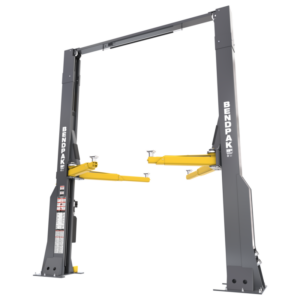
Safety locks are mechanical or hydraulic mechanisms that prevent the lift from lowering unexpectedly. Most portable car lifts include automatic safety locks that engage when the lift reaches a certain height. Some models also have manual lock pins that you insert into a hole on the column. These are especially useful when the lift is not powered or when you are working under the vehicle for an extended period. Always engage the locks before getting under the car, regardless of the lift's reputation.
Lifting Capacity and Weight Distribution
Lifting capacity is the maximum weight the lift can safely raise. For a portable car lift, that is typically between 6,000 and 10,000 pounds, enough for most passenger cars, SUVs, and light trucks. But capacity is not a simple number. The lift's rating assumes the load is evenly distributed across the platform or arms. If you place a heavy engine at one end of the lift, the actual stress on the structure may exceed the rating on that side. That is why many lifts have a rated capacity per arm or per post.
Also consider the vehicle's wheelbase. A longer wheelbase puts more load on the lift's front and rear points, which can reduce practical capacity compared to a shorter vehicle of the same total weight. Always check the manufacturer's guidelines for the specific model.
Concrete Thickness and Floor Condition
Portable car lifts are generally designed to sit on a flat, level concrete floor without being bolted down. But the floor must be strong enough to support the concentrated weight of the lift's feet. A four-post lift distributes weight across four points, each under a post. A two-post lift puts nearly all the load on two points. Over time, a weak or thin slab can crack or settle under the pressure.
A good rule is to have at least four inches of reinforced concrete, with a compressive strength of at least 3,000 psi. If the garage floor is older or has visible cracks, consider having a contractor evaluate it. Some portable lifts include a baseplate that spreads the load over a larger area, which helps on thinner slabs. For very heavy lifts, a plywood pad under each foot can also reduce point loading.
Choosing the Right Configuration
When comparing portable car lifts, think about how you will use the lift day to day. If you switch between cars frequently, a four-post lift with a wide platform is convenient because you drive straight on. If you do a lot of wheel or suspension work, a two-post lift gives better access to the undercarriage because there are no posts in the way. If floor space is tight, look for space saving vehicle lift options such as a scissor lift or a low-rise model that can be stored upright.
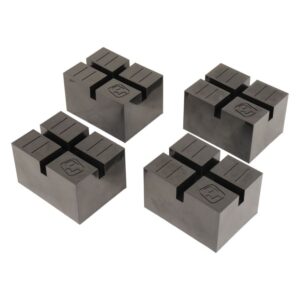
Also consider how often you will move the lift. Some portable models have casters that let you roll them around the garage, while others require partial disassembly to reposition. If you plan to store the lift against a wall when not in use, check the storage dimensions, not just the working footprint.
Putting It All Together
Selecting a portable car lift is about matching the machine to your garage and your work. Start with the ceiling clearance and bay space measurements, then narrow the list to lifts whose lift height and runway length fit the vehicles you work on. Check the concrete thickness and consider safety features like asymmetric arms and safety locks. The numbers on paper are a guide, but the real test is whether the lift gives you enough room to work safely and comfortably. Take the time to measure carefully, and you will end up with a tool that serves you well for years.